The chemistry of where materials meet.
We probe surfaces and interfaces to understand molecular organization, interactions, and material properties.
Sum Frequency Generation Spectroscopy
We use broadband sum frequency generation (SFG) spectroscopy to examine molecular structure, orientation, and chemical fingerprints at interfaces.
SFG combines infrared and visible light to generate a signal from an interface. Its sensitivity to molecular symmetry helps us study the thin region where two materials meet.
Browse publications ↗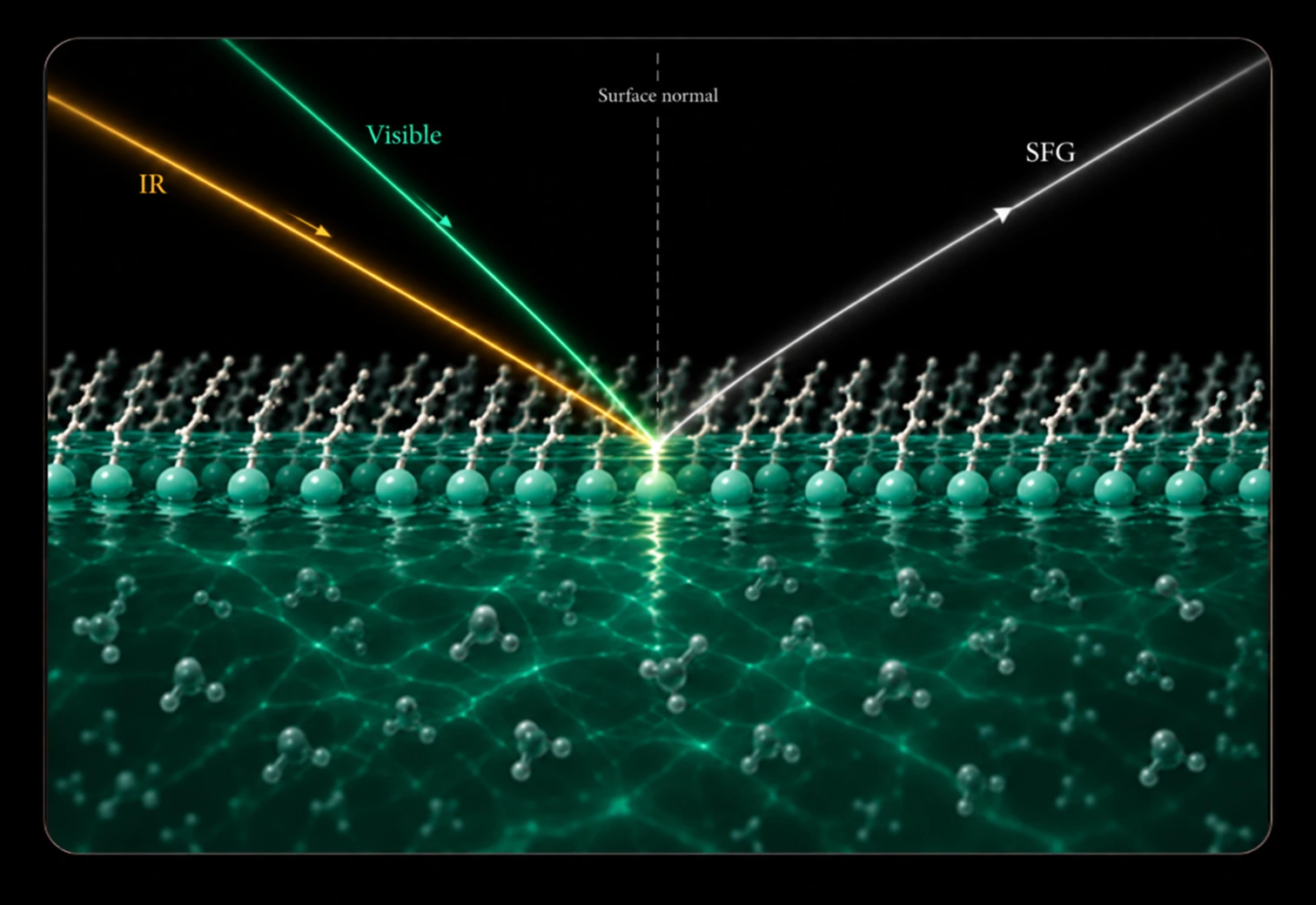
Seeing molecules at interfaces
Sum frequency generation spectroscopy probes molecular structure and organization at interfaces.
View precise beam geometry: 50° / 60° / 52°
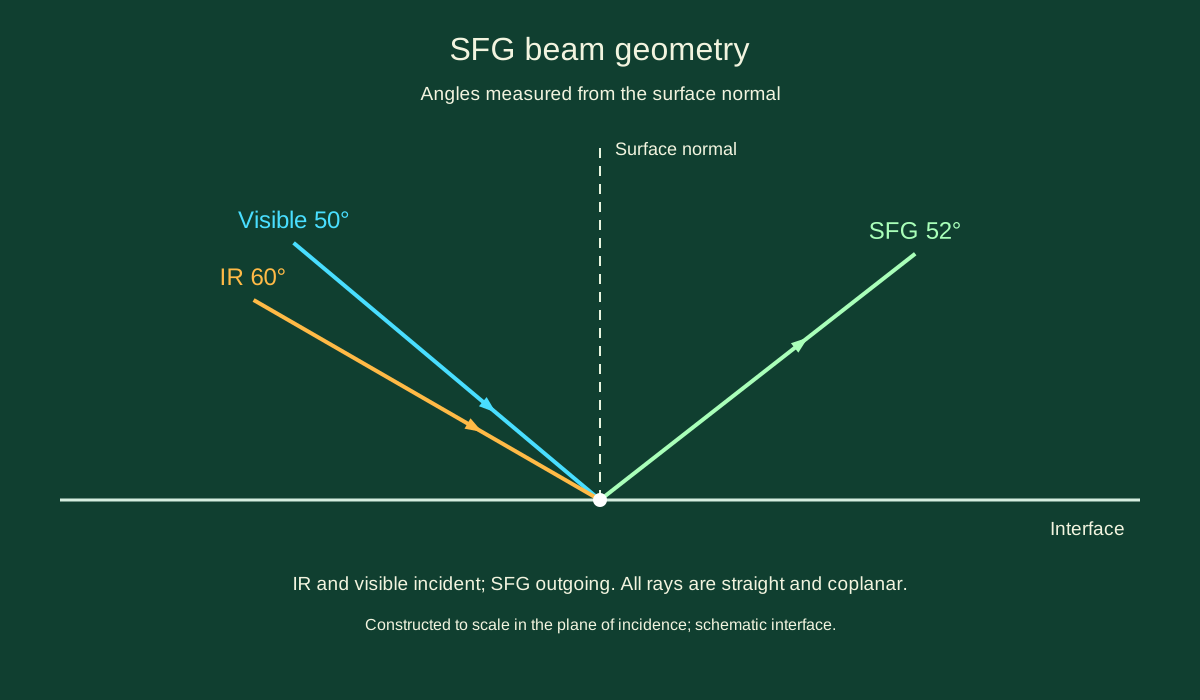
Angles from the surface normal: visible 50°, IR 60°, and outgoing SFG 52°. All three beams lie in the same plane of incidence.
Surfactants and Interfaces
Surfactants change how liquids interact with air, solids, and other liquids. We examine how adsorption, molecular conformation, and organization influence interfacial behavior.
For example, switchable surfactants provide a way to explore how changes in solution conditions influence molecular arrangement and emulsion stability.
Browse publications ↗
Small molecules. Large interfacial effects.
Surfactant adsorption and molecular organization shape the behavior of interfaces.
Polymer Surfaces and Materials
We investigate methacrylate copolymers, molecularly imprinted polymers, and chemically recyclable polyesters. The chemistry at a polymer surface can differ from its bulk composition.
Our work connects molecular organization and surface segregation with the properties that matter when a material contacts another phase.
Browse publications ↗
Connecting surface chemistry to material function
Molecular organization at polymer surfaces connects surface chemistry with material properties.
Biopolymers and Biomaterials
In collaboration with Dr. Held and his group, plant-based biopolymers, including extensins, offer a window into molecular self-assembly. We examine how these molecules organize at surfaces.
We also study materials for biomedical applications, where surface chemistry and material properties influence interactions with the surrounding environment.
Browse publications ↗
Learning from biological building blocks
Biological building blocks offer insight into molecular self-assembly and biomaterial surfaces.
Nanomaterials and Corrosion
Our interests include doped graphene quantum dots, nanoparticles, and the chemistry of metal surfaces.
By examining structure and interfacial interactions, we seek to understand the behavior of nanomaterials and the processes associated with corrosion.
Browse publications ↗
Chemistry at the smallest scales
Exploring nanomaterials, molecular interactions, and the chemistry of metal surfaces.
Techniques & instrumentation
Our research combines interfacial spectroscopy and surface characterization, with complementary measurements as appropriate to each project.